May 08, 2026
As the Federal Reserve (Fed) approaches a leadership transition, the institution once again finds itself at the center of both economic and political attention. The current Administration has nominated Kevin Warsh to succeed Jerome Powell when Powell’s term concludes this month.1 Warsh, a former Fed governor during the 2008 global financial crisis, is widely viewed as an experienced (but potentially more politically scrutinized) choice, particularly given ongoing debates around interest rates and inflation.2
His nomination, and the broader discussion surrounding it, highlights a theme that has defined the Federal Reserve since its founding: the ongoing tension between independence and accountability. While leadership changes often draw attention, history suggests something more important for investors—policy evolves, conditions change, but disciplined investment strategies endure.
That is especially relevant today. Regardless of the changing Fed chair, staying invested is the enduring message.
To understand why leadership transitions matter less than they appear, it is helpful to step back and examine how the Federal Reserve evolved.
The Fed was born out of crisis. Following the Panic of 1907, policymakers recognized the need for a more stable and responsive financial system.3 The result was the Federal Reserve Act of 1913, which created a uniquely American central bank. Rather than a single centralized authority, it was designed as a system of 12 regional banks overseen by a central board in Washington. This structure was meant to ensure the balancing of national authority with regional input.
At its core, the structure of the Federal Reserve is built on trust: how to establish it, maintain it, and protect it from shifting political and economic pressures.
From the beginning, the Fed needed to strike a delicate balance. It was established by and is accountable to Congress yet is expected to operate independently from day-to-day political pressures. This concept, often described as being “independent within government,” remains one of its defining characteristics.4
In practical terms, Federal Reserve independence means the ability to make monetary policy decisions, especially around interest rates, without direct political interference. This insulation is meant to help prevent short-term political incentives from undermining long-term economic stability.
However, independence has never been absolute. Fed independence has been tested by sitting presidents on several occasions, especially when political pressures collided with monetary policy. A well-known example came in the 1960s, when President Lyndon Johnson reportedly confronted Fed Chair William McChesney Martin in an intense and physically intimidating exchange over interest rates.5
Throughout its history, the Fed has continuously navigated tension between autonomy and accountability. Legislative changes such as the Banking Act of 1935 strengthened its independence, while periods of war, inflation, and financial stress have tested its limits.6
This tension is not a flaw; it is a feature. It reflects the reality that monetary policy operates within a broader political and economic system. And importantly, it reinforces a key point: leadership changes may influence tone and communication, but the institutional framework remains intact.
The Federal Reserve is not a static institution. It is one that has continuously adapted in response to economic shocks.
Across each of these periods, the tools evolved, the challenges changed, and leadership shifted. Yet the broader objective remained consistent: supporting economic stability over the long term.
For investors, this history reinforces an important lesson—economic environments will change, often unpredictably, but markets and institutions adapt over time.
While structure defines how the Fed operates, its mandate defines what it is trying to achieve. Following the Federal Reserve Reform Act of 1977, the Fed was formally tasked with promoting maximum employment and stable prices.
Full employment represents a labor market that is functioning efficiently—not overheated, but not weak. It allows for structural and frictional unemployment, but is not characterized by cyclical unemployment associated with economic downturns.
To assess this balance, the Fed compares the current unemployment rate to estimates such as the noncyclical rate of unemployment (NROU), often referred to as the “natural rate.”10 As of March 2026, unemployment stood at 4.3%, close to the estimated 4.4% NROU, which suggests a labor market that is within a sustainable range.11
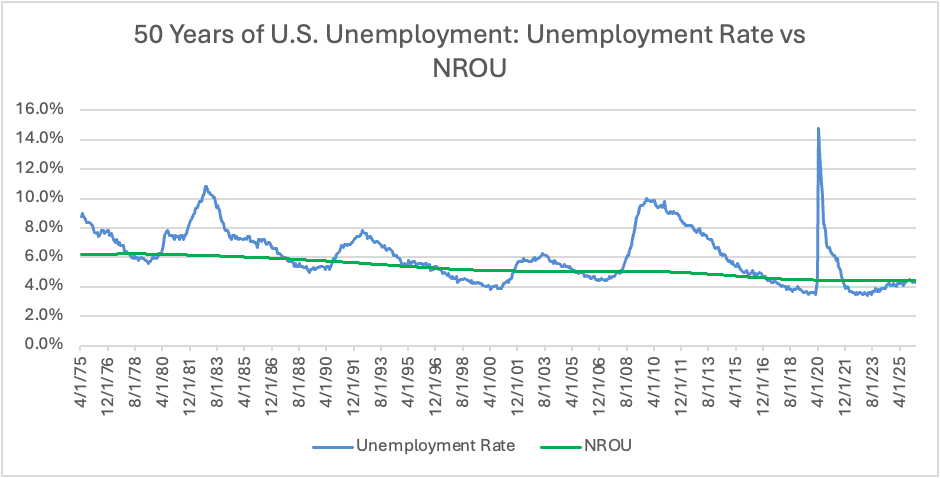
Sources: https://fred.stlouisfed.org/series/NROU and https://fred.stlouisfed.org/series/UNRATE
The second part of the mandate is stable prices. Although this is more straightforward in definition, it may not be in execution. The Fed targets inflation of 2% over the long term, typically measured by the core Personal Consumption Expenditures (PCE) price index, which excludes more volatile components such as food and energy.
Recent data analysis shows core PCE inflation at 3.2%, down from a peak of 5.4% in 2022, but still above target.12
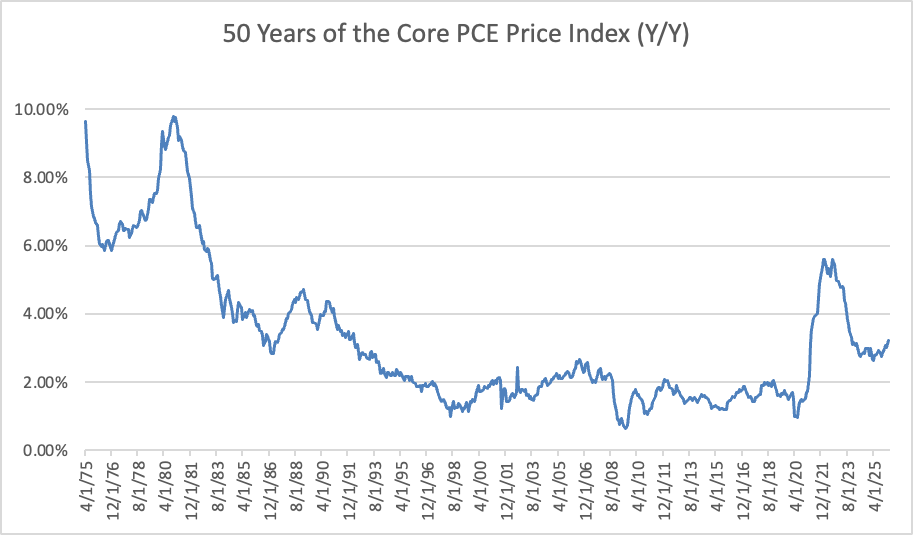
Source: https://fred.stlouisfed.org/series/PCEPILFE
Balancing these two objectives is inherently complex. Policies that support employment can increase inflationary pressures, while efforts to control inflation can slow economic growth.13 As a result, monetary policy is less about precision and more about continuous adjustment.
Recent geopolitical developments, particularly conflict in Iran and the closing of the Strait of Hormuz, have introduced a new layer of uncertainty into the economic outlook. Oil prices, measured by West Texas Intermediate, rose sharply from around $65 in early 2026 per barrel to over $100 in April.14 Because energy is a key input across industries, this increase has contributed to broader inflationary pressure.
The ultimate impact depends heavily on duration. A short-lived spike may have limited effects, while prolonged elevated prices could reduce consumer spending and increase the risk of stagflation. This environment places the Fed in a difficult position—respond too aggressively, and risk slowing the economy; respond too slowly, and risk allowing inflation to persist.
Research from former Fed chair Ben Bernanke provides useful context. His analysis suggests that past economic downturns associated with oil shocks were often driven more by aggressive interest rate increases than by the shocks themselves.15 This supports a more measured approach to policy, one that avoids overreacting to temporary supply-driven inflation.
Current Fed chair Powell reinforced this perspective. During a March press conference, he noted that it’s “standard learning that you ‘look through’ energy shocks, but that’s always been dependent on inflation expectations remaining well anchored.”16 Current market-based measures suggest that, for now, those expectations remain stable.
At One Day In July, portfolio construction is built on a simple principle: markets will change, but discipline should not. Rather than attempting to predict the exact path of monetary policy or economic cycles, we focus on building portfolios designed to perform across a range of environments.
A key component of this approach is the use of bonds structured to respond under different conditions. In periods of higher inflation and interest rates, they typically provide resilience through income. If growth slows and rates decline, they typically act as a stabilizer offering price appreciation.
This flexibility allows portfolios to adapt without constant adjustment. Fixed income in this context is not just a source of return, but a tool for managing uncertainty within a broader portfolio.
Today, the Federal Reserve’s independence remains under scrutiny, with political pressure and leadership changes contributing to uncertainty around future policy. Yet the principle is unchanged: effective monetary policy depends on credibility and decisions driven by economic data, not political timelines.
For investors, however, the implications are often overstated. Markets are forward looking, and attempts to reposition portfolios based on short-term expectations introduce costs and risks that can erode long-term returns. This is especially relevant given how difficult timing has historically been.
Periods of uncertainty do not invalidate a long-term strategy; they reinforce its importance. Our approach reflects a broader reality of the Federal Reserve continuing to evolve, leadership changing, and economic conditions shifting. These are not exceptions—they are defining features of markets.
Regardless of the Fed Chair, staying invested is the message. Investing for the long term remains the strategy.
One Day In July LLC is an SEC-registered investment advisor. Registration does not imply a certain level of skill or training. One Day In July LLC does not guarantee actual returns or losses. The content of this newsletter is for educational purposes only and is not investment advice. Individual circumstances may vary.
Sources:
[1] Reuters, Fed Chair Nomination (April 2026). https://www.reuters.com/world/us/senate-panel-vote-wednesday-advancing-fed-chair-warshs-nomination-2026-04-27/
[2] Fortune, Fed on Inflation and Independence (April 2026). https://fortune.com/2026/04/21/kevin-warsh-senate-banking-committee-statement-full-text-inflation-independence/
[3] The Federal Reserve, Explanation. https://www.federalreserve.gov/aboutthefed/fedexplained/who-we-are.htm
[4] The Federal Reserve, Independent Within Government (March 2017). https://www.federalreserve.gov/faqs/about_12799.htm
[5] Federal Reserve Bank of Richmond, 1965 Clash (Q3-4 2016), vol 21. https://www.federalreserve.gov/aboutthefed/files/the-fed-explained.pdf
[6] Federal Reserve History, Banking Act of 1935 (November 2013). https://www.federalreservehistory.org/essays/banking-act-of-1935
[7] The Federal Reserve, Annual Report of 1951 (March 1951). https://www.federalreserve.gov/monetarypolicy/files/fomcropa19510302.pdf
[8] Stanford University, How the Fed Works (March 2020). https://siepr.stanford.edu/publications/policy-brief/how-do-federal-reserves-new-tools-really-work
[9] The Federal Reserve, What the Central Bank Does (August 2021), page 34. https://www.federalreserve.gov/aboutthefed/files/the-fed-explained.pdf
[10] FRED, Federal Reserve Bank of St. Louis, Noncyclical Rate of Unemployment (May 2026). https://fred.stlouisfed.org/series/NROU
[11] FRED, Federal Reserve Bank of St. Louis, Unemployment Rate (May 2026). https://fred.stlouisfed.org/series/UNRATE
[12] Bureau of Economic Analysis, Personal Income and Outlays (March 2026). https://www.bea.gov/sites/default/files/2026-04/pi0326.pdf
[13] The Federal Reserve, Inflation and Unemployment (July 2024). https://www.federalreserve.gov/faqs/money_12856.htm
[14] Investing.com, Crude Oil Futures (May 2026). https://www.investing.com/commodities/crude-oil
[15] Brookings, Monetary Policy and Oil Prices (1997). https://www.brookings.edu/wp-content/uploads/1997/01/1997a_bpea_bernanke_gertler_watson_sims_friedman.pdf
[16] The Federal Reserve, Chair Powell’s Press Conference (March 2026). https://www.federalreserve.gov/mediacenter/files/FOMCpresconf20260318.pdf

v 2.4.161 | © One Day In July LLC. All Rights Reserved.


